ESOPs as Salary, Capital Gains, or Not Taxed at All
18 November 2026


AI Generated Podcast
This is an AI-generated (unedited and unreviewed) podcast for this article.
Key Takeaways
- ESOPs are usually taxed as salary on exercise, at slab rates of up to 30% plus surcharge, even though no cash is received
- The Income Tax Appellate Tribunal (ITAT) in Bangalore has now held that a repurchase of vested ESOPs before exercise is taxed as capital gains. At today’s rates, that is 12.5% instead of 30%, and the employee receives cash
- A one-time voluntary payment for a fall in the value of ESOPs, where the employee keeps the options, is a capital receipt and is not taxed at all. Three of four forums have accepted this in the Flipkart-PhonePe cases
- Tax deducted by the employer, and the description in Form 16, does not decide how the payment is taxed. The employee can report it under the correct head and claim a refund
Key Takeaways
- ESOPs are usually taxed as salary on exercise, at slab rates of up to 30% plus surcharge, even though no cash is received
- The Income Tax Appellate Tribunal (ITAT) in Bangalore has now held that a repurchase of vested ESOPs before exercise is taxed as capital gains. At today’s rates, that is 12.5% instead of 30%, and the employee receives cash
- A one-time voluntary payment for a fall in the value of ESOPs, where the employee keeps the options, is a capital receipt and is not taxed at all. Three of four forums have accepted this in the Flipkart-PhonePe cases
- Tax deducted by the employer, and the description in Form 16, does not decide how the payment is taxed. The employee can report it under the correct head and claim a refund
The Triggers
- When is it salary? An ESOP is taxed as salary on exercise. The difference between the fair market value of the share on the date of exercise and the exercise price is taxed as a perquisite under the head “salaries” at slab rates.1 Tax arises only when the shares are actually allotted.2
- When is it capital gains? An ESOP is taxed as capital gains on sale. The fair market value on which perquisite tax was paid becomes the cost of acquisition, and only the gain above that cost is taxed as capital gains. The amount already taxed as a perquisite is not taxed again.3
- What if ESOPs are repurchased before exercise? The payment is taxed as capital gains. In Pramod Kumar Jain, 4 the ITAT treated the repurchase of vested stock options as capital gains even though Form 165 and the buyback letter described the payment as salary. The ITAT held that the tax deducted by Flipkart was only an advance collection of tax and not a final determination of how the payment should be taxed.
- When is it a capital receipt? A payment is a capital receipt when the company makes a onetime voluntary payment for the loss in value of ESOPs and the employee keeps the ESOPs. If the payment is neither a perquisite nor capital gains, it is a capital receipt and is not taxable.
We analyze each of these situations below.
1. Salary Is Taxed on Exercise, Before Any Cash Is Received
An ESOP moves through five stages. The company grants the options, the options vest after at least one year,6 the employee exercises them, the company allots the shares, and the employee eventually sells the shares. Nothing is taxed at grant or vesting. The Income-tax Act taxes the employee at only two points, once as salary on allotment after exercise and again as capital gains on sale.
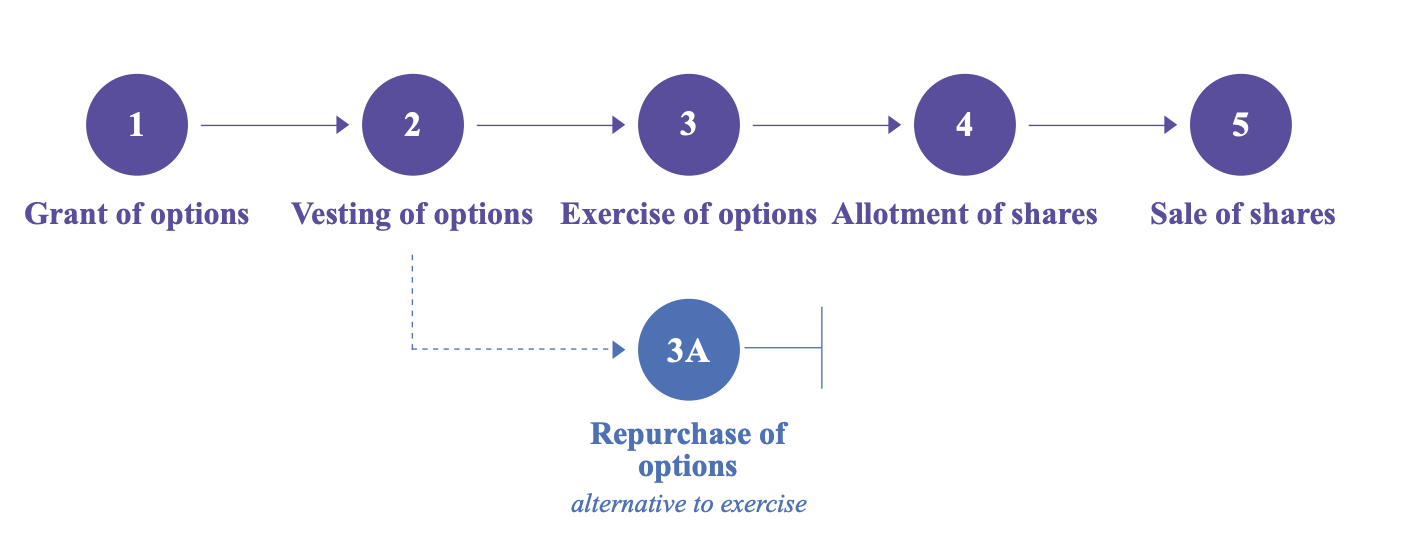
The problem lies at the first point. The employee pays tax at the top slab rate of 30% plus surcharge on a gain that exists only on paper. In an unlisted company, there is no market in which the employee can sell shares to pay that tax. If the value of the shares later falls, the perquisite tax is not refunded. This is dry tax.
Employees of eligible start-ups receive some relief. They pay the perquisite tax within 14 days of the earliest of three events, namely the expiry of 48 months from the end of the relevant assessment year, the sale of the shares, or the employee leaving the company.7 This relief defers the tax but does not reduce it.
2. Capital Gains Arise on Sale and Now on Repurchase Before Exercise
On sale. The gain over the fair market value at exercise is taxed as capital gains. Unlisted shares held for more than 24 months are taxed at 12.5%.8
On repurchase of options. The ITAT’s ruling in Pramod Kumar Jain addresses this situation.
The Facts That Mattered in Pramod Kumar Jain
- Jain held 2,653 vested options. He never exercised them, and no shares were ever allotted to him.
- Jain worked for Flipkart’s Indian subsidiary, but the options were issued by its Singapore parent.
- In FY 2019-20, the parent repurchased the options for INR 2.33 crore, and the options ceased to exist. The parent bought the options back rather than compensating Jain for a loss in their value.
- The employer withheld tax on the payment as salary, and both Form 16 and the buyback letter described the payment as salary.
- Jain reported the payment as long-term capital gains. The Assessing Officer reopened the assessment and taxed the payment as salary, and the Commissioner of Income Tax (Appeals) agreed..
What the ITAT Held
- The payment was not salary. Section 17(2)(vi) taxes a “specified security” that is allotted or transferred, valued on the date of exercise. Because Jain never exercised the options, no security came into existence and there was nothing to value. Where the computation fails, so does the charge.9
- The payment was capital gains. An unexercised option is a right to subscribe to shares, which makes it a capital asset.10 The buyback extinguished that right, which is a transfer.11
- Form 16 did not decide the issue. Tax deduction at source is a collection mechanism and does not determine the head of income.
- The identity of the employer did not need to be decided. Jain also argued that there could be no perquisite because the Singapore parent was not his employer. While the ITAT did not rule on this argument, the argument does not hold water because Section 17(2)(vi) covers securities allotted “directly or indirectly” by the employer.
The classification matters because of the difference in rates. Salary was taxed at a slab rate of 30%, while long-term capital gains were taxed at 20% at the time and are taxed at 12.5% today. At today’s rates, the employee pays less than half the tax. Because the employee paid nothing for the options, the full buyback price is likely to be treated as the gain.
The ITAT distinguished Nishithkumar Mehta, a Madras High Court decision discussed below, because the options in that case were never surrendered. The Revenue may appeal, but the Karnataka High Court has already held in Manjeet Singh Chawla that unexercised options are capital assets.
3. Capital Receipt Escapes Tax Altogether
The principle. Indian tax law taxes income, not every receipt. A receipt is taxed only if it falls under a head of income. For an ESOP holder, only two heads are realistic, salary and capital gains. A payment that fits neither head is a capital receipt and is not taxed.
When is a payment a capital receipt? In the context of ESOPs, the Flipkart-PhonePe cases show that payment to option holders has been treated as a capital receipt where three conditions were met:
- The options are not exercised. No shares are allotted, so there is no perquisite under Section 17(2)(vi).
- The employee gives nothing up. The employee keeps every option, and nothing is sold, surrendered, or cancelled. Because there is no transfer, there are no capital gains.
- The payment is not made for work. The payment is one-time and voluntary and is triggered by a corporate event. It is not owed under the ESOP plan and is not linked to service or performance, so it cannot be treated as salary in any other form.
The Flipkart-PhonePe payment. In December 2022, Flipkart divested its stake in PhonePe, and Flipkart options lost value as a result. In April 2023, Flipkart Singapore paid USD 43.67 per option to all holders as a one-time voluntary payment while stating that they had “no legal or contractual right” to this payment. Current and former employees were paid for their vested options, while only current employees were paid for unvested options. No option was cancelled by Flipkart, and they remained with the employee, and all three conditions were met. Tax was nevertheless withheld as salary, and four holders challenged the withholding.
| Case | Forum | Holder | Held |
|---|---|---|---|
| Sanjay Baweja12 | Delhi HC, May 2024 | Former employee | Capital receipt, not taxable |
| Nishithkumar Mehta13 | Madras HC, July 2024 | Current employee | Salary, taxable |
| Manjeet Singh Chawla14 | Karnataka HC, June 2025 | Current employee | Capital receipt, not taxable |
| Ankit Jain15 | ITAT Mumbai, August 2026 | Former employee | Capital receipt, not taxable |
Continued employment did not decide the outcome. Chawla was a current employee and still prevailed.
Why did the Madras High Court reach a different result? The court went further than the Revenue itself had argued. The order under challenge had already accepted that the payment was not a perquisite. The Revenue instead argued that the payment was capital gains because the employee had given up a “right to sue” for the loss in value, relying on K.R. Srinath, 16 where giving up a right to sue for specific performance of a property agreement had been taxed as capital gains. The court rejected that argument, accepting Flipkart’s submissions that the plan promised shares on exercise, not protection against a fall in value, and that a bare right to sue cannot be transferred in any event.
The Court ultimately held that the payment was salary indeed. It read the definition of “specified security,” which “includes the securities offered” under an ESOP plan,17 to cover the option itself. On that reading, cash paid to restore the value of an option is a perquisite even without exercise. The court also held that unexercised options are not capital assets, because they are contractual rights that cannot generate income or be monetized until shares are allotted. The other three forums disagree.
What is offered under the plan is the share, not the option, and the perquisite is valued on the date of exercise. Section 17(2)(vi) also taxes only securities that are “allotted or transferred,” and an option is merely granted. Without exercise, there is no value to compute and therefore no charge.18 On the capital asset point, we disagree with the Court in Nishithkumar as an option is itself a right relating to shares and is property even before any shares are allotted. That an option cannot yet be exercised or sold does not mean it has no value. The Madras decision is now in writ appeal.19
What the Revenue is likely to argue next. In Ankit Jain, the Revenue argued in the alternative that the payment was “profits in lieu of salary” under Section 17(3). The ITAT rejected that argument because the payment was not linked to employment, and relying on a different sub-clause did not change that. Section 56(2)(x), which taxes money received without consideration, has not yet been tested in these cases, and we expect the Revenue to rely on it. Section 56 in general came up only in Manjeet Singh Chawla, and it was raised by the court, not the Revenue. There, the court held on its own that because the payment was a capital receipt not chargeable as capital gains, it could not be taxed under any other head, including income from other sources. It relied on the principle that the heads of income are mutually exclusive.
Takeaways
1. ESOPs create dry tax, which is a poor outcome for employees. On exercise, the employee pays twice in cash, once for the exercise price and again for tax at slab rates. In an unlisted company, there is no market in which to sell the shares to fund either payment. If the company’s value later falls, the tax remains paid and the loss is only a capital loss. The start-up deferral postpones the tax but does not reduce it.
2. Pramod Kumar Jain offers a way out. The company or its parent buys back vested options before they are exercised. The price is fair value, which is the value of the share less the exercise price. The buyback extinguishes the option, which is a capital asset, so the gain is taxed as capital gains rather than salary. The employee receives cash, avoids dry tax, and pays less than half the tax.
Consider 10,000 options with an exercise price of INR 10 and shares worth INR 1,010 each.
| Case | Exercise and hold | Buyback before exercise |
|---|---|---|
| Cash paid by employee | INR 1 lakh | Nil |
| Cash received by employee | Nil | INR 1 crore |
| Head of income | Salary | Capital gains |
| Rate | 30% plus surcharge | 12.5% |
| Tax | More than INR 30 lakh | About INR 12.5 lakh |
The 12.5% rate applies if the options were held for more than 24 months from grant.
- The grounds are now stronger. The ITAT has ruled directly on a buyback, and the Karnataka High Court has held in Manjeet Singh Chawla that unexercised options are capital assets. The main risk is the Madras High Court’s contrary view in Nishithkumar Mehta, which is under appeal.
- Structure it carefully. Price the buyback at fair value, keep it at the company’s discretion, and do not tie it to service or performance.
3. The company will still deduct tax as salary, and it probably should. The employer bears the risk of short deduction, including tax, interest, and penalties. It will deduct at slab rates and report the payment as salary in Form 16, which is perhaps the safest approach for an employer. That treatment does not bind the employee, because tax deduction at source does not determine the head of income. The employee can report the payment as capital gains and claim a refund or apply in advance for a lower deduction certificate. The company decides what to withhold, and the employee decides how to report. Of course, if the employer wants to optimize taxes for the employee, then no TDS should be deducted in the first place. Employers should choose the treatment that matches the employee expectations and the appetite for a dispute. Some instruments leave no choice. Cash-settled stock appreciation rights, for instance, are likely to be taxed in full as salary.
4. Capital gains treatment is safer than capital receipt treatment. A capital receipt escapes tax altogether, which is why the Revenue resists it most strongly. It works only if the options are not exercised, the employee keeps every option, and the payment is a one-time voluntary payment triggered by a corporate event. Three of four forums have accepted it, but the Madras High Court has not and Section 56(2)(x) remains untested. The company must choose this structure deliberately. It should record that holders have no contractual right to the payment, tie the payment to the corporate event, and leave the options untouched. If any condition fails, the payment could fall back into salary.
5. Rank the options by risk. Each step down the ladder lowers the tax and raises the risk of a dispute.
| Treatment | Tax cost | Risk of dispute |
|---|---|---|
| Perquisite on exercise | Highest, at slab rates | Lowest |
| Capital gains on buyback | 12.5% | Moderate, with ITAT and Karnataka High Court support |
| Capital receipt | Nil | Highest, with forums divided |
1 Section 17(2)(vi), Explanation (c), Income-tax Act, 1961 (now Section 17(1)(d), Income-tax Act, 2025), with fair market value determined under Rule 3(8), Income-tax Rules, 1962. Section 17(2)(vi) taxes “the value of any specified security or sweat equity shares allotted or transferred, directly or indirectly, by the employer, or former employer, free of cost or at concessional rate to the assessee.” Under Explanation (c), that value is “the fair market value of the specified security or sweat equity shares, as the case may be, on the date on which the option is exercised by the assessee as reduced by the amount actually paid by, or recovered from, the assessee in respect of such security or shares.” References in this article are to the Income-tax Act, 1961, which governed the years in dispute in the cases discussed. The Income-tax Act, 2025 applies from April 1, 2026.
2 Bharat Financial Inclusion Ltd. v. DCIT, (2018) 172 ITD 198 (Hyd. Trib.).
3 Section 49(2AA), Income-tax Act, 1961 (now Section 73(1), Income-tax Act, 2025). Where the capital gain arises from the transfer of a specified security referred to in Section 17(2)(vi), its cost is “the fair market value which has been taken into account for the purposes of the said sub-clause.”
4 Pramod Kumar Jain v. DCIT, ITA No. 3034/Bang/2025 (ITAT Bangalore July 30, 2026).
5 Form 16 is the certificate of tax deducted at source that an employer issues to an employee under Section 203, Income-tax Act, 1961, read with Rule 31, Income-tax Rules, 1962.
6 Section 62(1)(b), Companies Act, 2013, and Rule 12, Companies (Share Capital and Debentures) Rules, 2014. For listed companies, Regulation 18(1), SEBI (Share Based Employee Benefits and Sweat Equity) Regulations, 2021, also prescribes a minimum vesting period of one year.
7 Sections 191(2) and 192(1C), Income-tax Act, 1961, for start-ups eligible under Section 80-IAC. An eligible start-up is a company or limited liability partnership incorporated on or after April 1, 2016 but before April 1, 2030, whose turnover does not exceed INR100 crore in the relevant year, and which holds a certificate of eligible business from the Inter-Ministerial Board of Certification.
8 Section 112, Income-tax Act, 1961. The rate is 12.5% (without indexation) for transfers on or after July 23, 2024, and 20% (with indexation) for earlier transfers. Unlisted shares are long-term capital assets if held for more than 24 months.
9 CIT v. B.C. Srinivasa Setty, (1981) 2 SCC 460. The Supreme Court held that where the computation provisions cannot apply, the charging provision does not apply either.
10 Section 2(14) read with Explanation 1(i)(e) to Section 2(42A), Income-tax Act, 1961 (“right to subscribe to any financial asset”). Section 2(14) defines a capital asset as “property of any kind held by an assessee, whether or not connected with his business or profession.”
11 Section 2(47), Income-tax Act, 1961. Clauses (i) and (ii) of Section 2(47) cover “the sale, exchange or relinquishment of the asset” and “the extinguishment of any rights therein.”
12 Sanjay Baweja v. DCIT, [2025] 474 ITR 376 (Del.) (May 30, 2024).
13 Nishithkumar Mukeshkumar Mehta v. DCIT, [2025] 475 ITR 614 (Mad.) (July 31, 2024).
14 Manjeet Singh Chawla v. DCIT, 2025:KHC:18579 (Kar. June 2, 2025)
15 Ankit Jain v. DCIT, ITA No. 7979/Mum/2026 (ITAT Mumbai Aug. 28, 2026).
16 K.R. Srinath v. ACIT, T.C.A. No. 59 of 2002 (Mad. Apr. 20, 2004).
17 Section 17(2)(vi), Explanation (a), Income-tax Act, 1961. Explanation (a) provides that “specified security” means the securities as defined in Section 2(h) of the Securities Contracts (Regulation) Act, 1956 “and, where employees’ stock option has been granted under any plan or scheme therefor, includes the securities offered under such plan or scheme.” Explanation (e) separately defines an “option” as “a right but not an obligation granted to an employee to apply for the specified security or sweat equity shares at a predetermined price.”
18 B.C. Srinivasa Setty, supra.
19 W.A. No. 198 of 2025 (Mad.), pending before the Madras High Court, as recorded in Manjeet Singh Chawla at para 7(viii).
The Triggers
- When is it salary? An ESOP is taxed as salary on exercise. The difference between the fair market value of the share on the date of exercise and the exercise price is taxed as a perquisite under the head “salaries” at slab rates.1 Tax arises only when the shares are actually allotted.2
- When is it capital gains? An ESOP is taxed as capital gains on sale. The fair market value on which perquisite tax was paid becomes the cost of acquisition, and only the gain above that cost is taxed as capital gains. The amount already taxed as a perquisite is not taxed again.3
- What if ESOPs are repurchased before exercise? The payment is taxed as capital gains. In Pramod Kumar Jain, 4 the ITAT treated the repurchase of vested stock options as capital gains even though Form 165 and the buyback letter described the payment as salary. The ITAT held that the tax deducted by Flipkart was only an advance collection of tax and not a final determination of how the payment should be taxed.
- When is it a capital receipt? A payment is a capital receipt when the company makes a onetime voluntary payment for the loss in value of ESOPs and the employee keeps the ESOPs. If the payment is neither a perquisite nor capital gains, it is a capital receipt and is not taxable.
We analyze each of these situations below.
1. Salary Is Taxed on Exercise, Before Any Cash Is Received
An ESOP moves through five stages. The company grants the options, the options vest after at least one year,6 the employee exercises them, the company allots the shares, and the employee eventually sells the shares. Nothing is taxed at grant or vesting. The Income-tax Act taxes the employee at only two points, once as salary on allotment after exercise and again as capital gains on sale.
The problem lies at the first point. The employee pays tax at the top slab rate of 30% plus surcharge on a gain that exists only on paper. In an unlisted company, there is no market in which the employee can sell shares to pay that tax. If the value of the shares later falls, the perquisite tax is not refunded. This is dry tax.
Employees of eligible start-ups receive some relief. They pay the perquisite tax within 14 days of the earliest of three events, namely the expiry of 48 months from the end of the relevant assessment year, the sale of the shares, or the employee leaving the company.7 This relief defers the tax but does not reduce it.
2. Capital Gains Arise on Sale and Now on Repurchase Before Exercise
On sale. The gain over the fair market value at exercise is taxed as capital gains. Unlisted shares held for more than 24 months are taxed at 12.5%.8
On repurchase of options. The ITAT’s ruling in Pramod Kumar Jain addresses this situation.
The Facts That Mattered in Pramod Kumar Jain
- Jain held 2,653 vested options. He never exercised them, and no shares were ever allotted to him.
- Jain worked for Flipkart’s Indian subsidiary, but the options were issued by its Singapore parent.
- In FY 2019-20, the parent repurchased the options for INR 2.33 crore, and the options ceased to exist. The parent bought the options back rather than compensating Jain for a loss in their value.
- The employer withheld tax on the payment as salary, and both Form 16 and the buyback letter described the payment as salary.
- Jain reported the payment as long-term capital gains. The Assessing Officer reopened the assessment and taxed the payment as salary, and the Commissioner of Income Tax (Appeals) agreed..
What the ITAT Held
- The payment was not salary. Section 17(2)(vi) taxes a “specified security” that is allotted or transferred, valued on the date of exercise. Because Jain never exercised the options, no security came into existence and there was nothing to value. Where the computation fails, so does the charge.9
- The payment was capital gains. An unexercised option is a right to subscribe to shares, which makes it a capital asset.10 The buyback extinguished that right, which is a transfer.11
- Form 16 did not decide the issue. Tax deduction at source is a collection mechanism and does not determine the head of income.
- The identity of the employer did not need to be decided. Jain also argued that there could be no perquisite because the Singapore parent was not his employer. While the ITAT did not rule on this argument, the argument does not hold water because Section 17(2)(vi) covers securities allotted “directly or indirectly” by the employer.
The classification matters because of the difference in rates. Salary was taxed at a slab rate of 30%, while long-term capital gains were taxed at 20% at the time and are taxed at 12.5% today. At today’s rates, the employee pays less than half the tax. Because the employee paid nothing for the options, the full buyback price is likely to be treated as the gain.
The ITAT distinguished Nishithkumar Mehta, a Madras High Court decision discussed below, because the options in that case were never surrendered. The Revenue may appeal, but the Karnataka High Court has already held in Manjeet Singh Chawla that unexercised options are capital assets.
3. Capital Receipt Escapes Tax Altogether
The principle. Indian tax law taxes income, not every receipt. A receipt is taxed only if it falls under a head of income. For an ESOP holder, only two heads are realistic, salary and capital gains. A payment that fits neither head is a capital receipt and is not taxed.
When is a payment a capital receipt? In the context of ESOPs, the Flipkart-PhonePe cases show that payment to option holders has been treated as a capital receipt where three conditions were met:
- The options are not exercised. No shares are allotted, so there is no perquisite under Section 17(2)(vi).
- The employee gives nothing up. The employee keeps every option, and nothing is sold, surrendered, or cancelled. Because there is no transfer, there are no capital gains.
- The payment is not made for work. The payment is one-time and voluntary and is triggered by a corporate event. It is not owed under the ESOP plan and is not linked to service or performance, so it cannot be treated as salary in any other form.
The Flipkart-PhonePe payment. In December 2022, Flipkart divested its stake in PhonePe, and Flipkart options lost value as a result. In April 2023, Flipkart Singapore paid USD 43.67 per option to all holders as a one-time voluntary payment while stating that they had “no legal or contractual right” to this payment. Current and former employees were paid for their vested options, while only current employees were paid for unvested options. No option was cancelled by Flipkart, and they remained with the employee, and all three conditions were met. Tax was nevertheless withheld as salary, and four holders challenged the withholding.
| Case | Forum | Holder | Held |
|---|---|---|---|
| Sanjay Baweja12 | Delhi HC, May 2024 | Former employee | Capital receipt, not taxable |
| Nishithkumar Mehta13 | Madras HC, July 2024 | Current employee | Salary, taxable |
| Manjeet Singh Chawla14 | Karnataka HC, June 2025 | Current employee | Capital receipt, not taxable |
| Ankit Jain15 | ITAT Mumbai, August 2026 | Former employee | Capital receipt, not taxable |
Continued employment did not decide the outcome. Chawla was a current employee and still prevailed.
Why did the Madras High Court reach a different result? The court went further than the Revenue itself had argued. The order under challenge had already accepted that the payment was not a perquisite. The Revenue instead argued that the payment was capital gains because the employee had given up a “right to sue” for the loss in value, relying on K.R. Srinath, 16 where giving up a right to sue for specific performance of a property agreement had been taxed as capital gains. The court rejected that argument, accepting Flipkart’s submissions that the plan promised shares on exercise, not protection against a fall in value, and that a bare right to sue cannot be transferred in any event.
The Court ultimately held that the payment was salary indeed. It read the definition of “specified security,” which “includes the securities offered” under an ESOP plan,17 to cover the option itself. On that reading, cash paid to restore the value of an option is a perquisite even without exercise. The court also held that unexercised options are not capital assets, because they are contractual rights that cannot generate income or be monetized until shares are allotted. The other three forums disagree.
What is offered under the plan is the share, not the option, and the perquisite is valued on the date of exercise. Section 17(2)(vi) also taxes only securities that are “allotted or transferred,” and an option is merely granted. Without exercise, there is no value to compute and therefore no charge.18 On the capital asset point, we disagree with the Court in Nishithkumar as an option is itself a right relating to shares and is property even before any shares are allotted. That an option cannot yet be exercised or sold does not mean it has no value. The Madras decision is now in writ appeal.19
What the Revenue is likely to argue next. In Ankit Jain, the Revenue argued in the alternative that the payment was “profits in lieu of salary” under Section 17(3). The ITAT rejected that argument because the payment was not linked to employment, and relying on a different sub-clause did not change that. Section 56(2)(x), which taxes money received without consideration, has not yet been tested in these cases, and we expect the Revenue to rely on it. Section 56 in general came up only in Manjeet Singh Chawla, and it was raised by the court, not the Revenue. There, the court held on its own that because the payment was a capital receipt not chargeable as capital gains, it could not be taxed under any other head, including income from other sources. It relied on the principle that the heads of income are mutually exclusive.
Takeaways
1. ESOPs create dry tax, which is a poor outcome for employees. On exercise, the employee pays twice in cash, once for the exercise price and again for tax at slab rates. In an unlisted company, there is no market in which to sell the shares to fund either payment. If the company’s value later falls, the tax remains paid and the loss is only a capital loss. The start-up deferral postpones the tax but does not reduce it.
2. Pramod Kumar Jain offers a way out. The company or its parent buys back vested options before they are exercised. The price is fair value, which is the value of the share less the exercise price. The buyback extinguishes the option, which is a capital asset, so the gain is taxed as capital gains rather than salary. The employee receives cash, avoids dry tax, and pays less than half the tax.
Consider 10,000 options with an exercise price of INR 10 and shares worth INR 1,010 each.
| Case | Exercise and hold | Buyback before exercise |
|---|---|---|
| Cash paid by employee | INR 1 lakh | Nil |
| Cash received by employee | Nil | INR 1 crore |
| Head of income | Salary | Capital gains |
| Rate | 30% plus surcharge | 12.5% |
| Tax | More than INR 30 lakh | About INR 12.5 lakh |
The 12.5% rate applies if the options were held for more than 24 months from grant.
- The grounds are now stronger. The ITAT has ruled directly on a buyback, and the Karnataka High Court has held in Manjeet Singh Chawla that unexercised options are capital assets. The main risk is the Madras High Court’s contrary view in Nishithkumar Mehta, which is under appeal.
- Structure it carefully. Price the buyback at fair value, keep it at the company’s discretion, and do not tie it to service or performance.
3. The company will still deduct tax as salary, and it probably should. The employer bears the risk of short deduction, including tax, interest, and penalties. It will deduct at slab rates and report the payment as salary in Form 16, which is perhaps the safest approach for an employer. That treatment does not bind the employee, because tax deduction at source does not determine the head of income. The employee can report the payment as capital gains and claim a refund or apply in advance for a lower deduction certificate. The company decides what to withhold, and the employee decides how to report. Of course, if the employer wants to optimize taxes for the employee, then no TDS should be deducted in the first place. Employers should choose the treatment that matches the employee expectations and the appetite for a dispute. Some instruments leave no choice. Cash-settled stock appreciation rights, for instance, are likely to be taxed in full as salary.
4. Capital gains treatment is safer than capital receipt treatment. A capital receipt escapes tax altogether, which is why the Revenue resists it most strongly. It works only if the options are not exercised, the employee keeps every option, and the payment is a one-time voluntary payment triggered by a corporate event. Three of four forums have accepted it, but the Madras High Court has not and Section 56(2)(x) remains untested. The company must choose this structure deliberately. It should record that holders have no contractual right to the payment, tie the payment to the corporate event, and leave the options untouched. If any condition fails, the payment could fall back into salary.
5. Rank the options by risk. Each step down the ladder lowers the tax and raises the risk of a dispute.
| Treatment | Tax cost | Risk of dispute |
|---|---|---|
| Perquisite on exercise | Highest, at slab rates | Lowest |
| Capital gains on buyback | 12.5% | Moderate, with ITAT and Karnataka High Court support |
| Capital receipt | Nil | Highest, with forums divided |
1 Section 17(2)(vi), Explanation (c), Income-tax Act, 1961 (now Section 17(1)(d), Income-tax Act, 2025), with fair market value determined under Rule 3(8), Income-tax Rules, 1962. Section 17(2)(vi) taxes “the value of any specified security or sweat equity shares allotted or transferred, directly or indirectly, by the employer, or former employer, free of cost or at concessional rate to the assessee.” Under Explanation (c), that value is “the fair market value of the specified security or sweat equity shares, as the case may be, on the date on which the option is exercised by the assessee as reduced by the amount actually paid by, or recovered from, the assessee in respect of such security or shares.” References in this article are to the Income-tax Act, 1961, which governed the years in dispute in the cases discussed. The Income-tax Act, 2025 applies from April 1, 2026.
2 Bharat Financial Inclusion Ltd. v. DCIT, (2018) 172 ITD 198 (Hyd. Trib.).
3 Section 49(2AA), Income-tax Act, 1961 (now Section 73(1), Income-tax Act, 2025). Where the capital gain arises from the transfer of a specified security referred to in Section 17(2)(vi), its cost is “the fair market value which has been taken into account for the purposes of the said sub-clause.”
4 Pramod Kumar Jain v. DCIT, ITA No. 3034/Bang/2025 (ITAT Bangalore July 30, 2026).
5 Form 16 is the certificate of tax deducted at source that an employer issues to an employee under Section 203, Income-tax Act, 1961, read with Rule 31, Income-tax Rules, 1962.
6 Section 62(1)(b), Companies Act, 2013, and Rule 12, Companies (Share Capital and Debentures) Rules, 2014. For listed companies, Regulation 18(1), SEBI (Share Based Employee Benefits and Sweat Equity) Regulations, 2021, also prescribes a minimum vesting period of one year.
7 Sections 191(2) and 192(1C), Income-tax Act, 1961, for start-ups eligible under Section 80-IAC. An eligible start-up is a company or limited liability partnership incorporated on or after April 1, 2016 but before April 1, 2030, whose turnover does not exceed INR100 crore in the relevant year, and which holds a certificate of eligible business from the Inter-Ministerial Board of Certification.
8 Section 112, Income-tax Act, 1961. The rate is 12.5% (without indexation) for transfers on or after July 23, 2024, and 20% (with indexation) for earlier transfers. Unlisted shares are long-term capital assets if held for more than 24 months.
9 CIT v. B.C. Srinivasa Setty, (1981) 2 SCC 460. The Supreme Court held that where the computation provisions cannot apply, the charging provision does not apply either.
10 Section 2(14) read with Explanation 1(i)(e) to Section 2(42A), Income-tax Act, 1961 (“right to subscribe to any financial asset”). Section 2(14) defines a capital asset as “property of any kind held by an assessee, whether or not connected with his business or profession.”
11 Section 2(47), Income-tax Act, 1961. Clauses (i) and (ii) of Section 2(47) cover “the sale, exchange or relinquishment of the asset” and “the extinguishment of any rights therein.”
12 Sanjay Baweja v. DCIT, [2025] 474 ITR 376 (Del.) (May 30, 2024).
13 Nishithkumar Mukeshkumar Mehta v. DCIT, [2025] 475 ITR 614 (Mad.) (July 31, 2024).
14 Manjeet Singh Chawla v. DCIT, 2025:KHC:18579 (Kar. June 2, 2025)
15 Ankit Jain v. DCIT, ITA No. 7979/Mum/2026 (ITAT Mumbai Aug. 28, 2026).
16 K.R. Srinath v. ACIT, T.C.A. No. 59 of 2002 (Mad. Apr. 20, 2004).
17 Section 17(2)(vi), Explanation (a), Income-tax Act, 1961. Explanation (a) provides that “specified security” means the securities as defined in Section 2(h) of the Securities Contracts (Regulation) Act, 1956 “and, where employees’ stock option has been granted under any plan or scheme therefor, includes the securities offered under such plan or scheme.” Explanation (e) separately defines an “option” as “a right but not an obligation granted to an employee to apply for the specified security or sweat equity shares at a predetermined price.”
18 B.C. Srinivasa Setty, supra.
19 W.A. No. 198 of 2025 (Mad.), pending before the Madras High Court, as recorded in Manjeet Singh Chawla at para 7(viii).
AI Generated Podcast
This is an AI-generated (unedited and unreviewed) podcast for this article.
Recent Research
View All →
Loading recent analysis...
Loading recent analysis...

Only Indian law firm commended for Innovation in ‘Dealmaking’ category
at the FT Innovative Lawyers Awards Asia-Pacific 2024
Join our Whatsapp Community
Click here or scan the QR code to join our WhatsApp community