Public M&A: Should veto rights trigger an open offer?
3 November 2026


AI Generated Podcast
This is an AI-generated (unedited and unreviewed) podcast for this article.
Key Takeaways
- Negative control is not control. Is that the starting point for Advent acquiring a 24.87% investment in Yatharth Hospitals? Is ArcelorMittal the bright-line?
- Supreme Court’s recent decision in ECL Finance – supports the position that only positive control is control (though again in IBC context).
- The law does not sit easily with logic. Could rights extend way beyond board representation to specified borrowing, capital expenditure, acquisitions, asset sales, related-party transactions and equity issuances? What about findings in Future Retail v. Amazon?
- ‘Investor protection’ v. ‘day-to-day control’. Does that distinction even matter?
- Must control always be positive? Is SEBI writing a new rule book?
Key Takeaways
- Negative control is not control. Is that the starting point for Advent acquiring a 24.87% investment in Yatharth Hospitals? Is ArcelorMittal the bright-line?
- Supreme Court’s recent decision in ECL Finance – supports the position that only positive control is control (though again in IBC context).
- The law does not sit easily with logic. Could rights extend way beyond board representation to specified borrowing, capital expenditure, acquisitions, asset sales, related-party transactions and equity issuances? What about findings in Future Retail v. Amazon?
- ‘Investor protection’ v. ‘day-to-day control’. Does that distinction even matter?
- Must control always be positive? Is SEBI writing a new rule book?
For the longest time, dealmakers have debated on whether veto rights transgress into the domain of control or can they be argued to be limited within the realm of mere investor protection matters. There is a long history of cases and SEBI consultation papers debating which veto rights percolate to control, and which do not.
Interestingly, Supreme Court settled the debate in ArcelorMittal1 in 2018 holding that veto rights will not amount to control obviating the debate on which veto rights amount to control and which are mere investor protection. The Supreme Court’s decision was premised on its plain reading of definition of ‘control’, inasmuch as it is the power to direct, not to merely block a company’s decisions. And unless an investor is in the driver’s seat, he cannot be said to be in control.
But just like Azadi Bachao Andolan couldn’t stop the debate on treaty abuse despite a valid TRC, jury continued to be out on interpretation of ‘control’. Given early cases on the point, SEBI’s past consultation materials and the FRL-Amazon2 prima facie finding that veto rights could amount to control continues to scare deal makers. After all, it only took one Tiger Walmart ruling (even though it was prima facie as well) to overturn years of jurisprudence.
That debate has resurfaced with Advent’s recent investment in Yatharth Hospitals – below the open offer trigger, but rights that SEBI could argue could amount to ‘control’. Should an open offer be made or not? The question, therefore, is how does an investor protect its investment without crossing the legal threshold of control.
‘Control’ is not just an open offer issue. It can trigger regulatory consequences wherever the term ‘control’ is used - approvals in BFSI, exchange control laws – to name a few.
In this article, we analyse the evolution of ‘control’ from the lens of a dealmaker.
What is control?
Section 2(27) of the Companies Act defines control as:
“includes the right to appoint a majority of the directors, or to control the management or policy decisions, exercisable individually or in concert, directly or indirectly, by virtue of shareholding, management rights, shareholders’ agreements, voting agreements or in any other manner”.
The Takeover Code, RBI’s NBFC framework and the foreign investment rules use materially the same definition.
The definition has two limbs. The first is ‘de jure’ control (i.e. objective/ bright line): the right to appoint a majority of the board. The second is ‘de facto’ control (practical and open-ended): the ability to control management decisions (how the company is run day to day) or policy decisions (long-term decisions beyond day-to-day affairs).3
The question that remains heavily debated is - whether the right to stop a decision is control. That is the debate between positive control (the ability to make the company do something) and negative control (the ability to prevent it from doing something). Courts have consistently debated – who is in the driving seat after all? The key cases shaping this debate are set out in Annexure I below.
Let’s start from the beginning.
How did we get here?
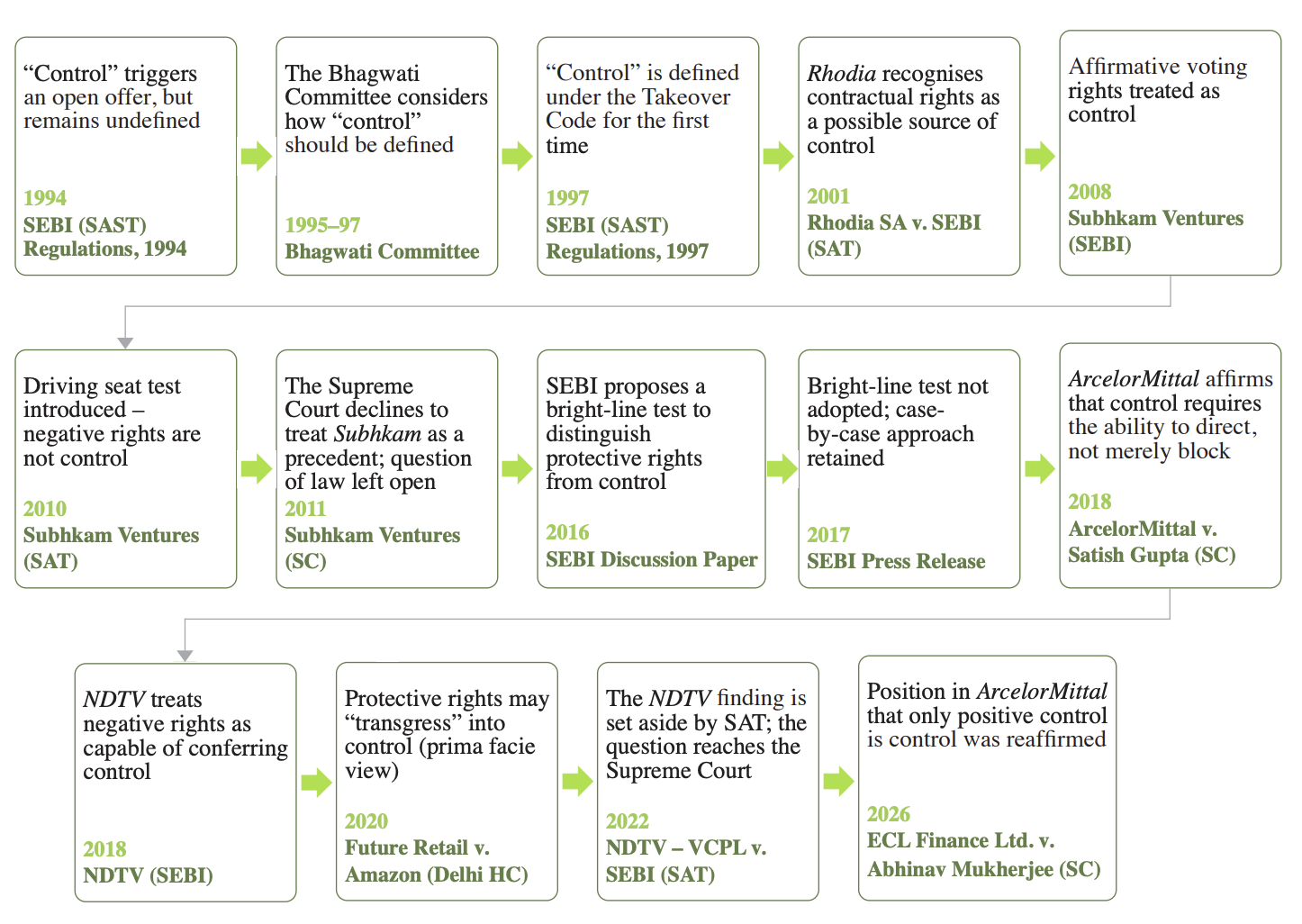
Do veto rights confer control?
Rhodia SA v. SEBI4 first discussed negative control in 2001 and said ‘yes’. Rhodia held no shares in the target, but the Securities Appellate Tribunal (SAT) found that prior-approval rights over dividends, major asset transfers, securities issuances, business strategy, key markets, restructuring and senior management placed it in “control of management and policy”. Why? This wasn’t immediately clear from their reasoning.
In Subhkam Ventures5 , the SAT in 2010 said no:
“Control, according to the definition, is a proactive and not a reactive power… power by which an acquirer can only prevent a company from doing what the latter wants to do is by itself not control.”
The test there was whether the acquirer was in the driving seat: whether it controlled “the steering, accelerator, the gears and the brakes”. An investor who can only say “don’t turn right” is not driving. However, the Supreme Court did not decide the point and directed that the SAT order was not to be treated as a precedent.6 So the risk remained.
For 8 years after – that question remained open. The position for dealmakers then was to avoid veto rights in public listed companies altogether.
In 2018, the Supreme Court finally provided guidance in ArcelorMittal, answering the question it had left open. Interpreting “control” by reference to Section 2(27) of the Companies Act, the Supreme Court held that control “denotes only positive control, which means that the mere power to block special resolutions of a company cannot amount to control”. It reproduced SAT’s driving-seat passage from Subhkam in full and upheld those observations:
“The test really is whether the acquirer is in the driving seat. To extend the metaphor further, the question would be whether he controls the steering, accelerator, the gears and the brakes. If the answer to these questions is in the affirmative, then alone would he be in control of the company. In other words, the question to be asked in each case would be whether the acquirer is the driving force behind the company and whether he is the one providing motion to the organization. If yes, he is in control but not otherwise. In short control means effective control.”
Therefore, a plain reading of the law and the decisions support the argument that blocking rights do not automatically amount to control.
Then, in FRL-Amazon (2020) Delhi High Court held veto rights amounted control on the grounds that certain rights transgressed into the realm of proactive control. The Court held that the veto rights in relation to charter amendments, capital structure, material divestments and acquisitions “are meant for protection of the investment and may not amount to control”. The individual rights do not matter as much as the ratio – that veto rights could amount to control, a premise that was severely debilitated in ArcelorMittal.
Note that FRL – Amazon was only a prima facie view. As against FRL – Amazon, the following decisions set out that only positive control will qualify as control – (a) SAT in 2010 in Subhkam laid down the driving seat test (though the SC held against use of Subhkam as a precedent); (b) SC in ArcelorMittal in 2018; (c) SAT in NDTV in 2022 (currently in appeal though); and most recently (d) the Supreme Court in ECL Finance Ltd. v. Abhinav Mukherjee.
The ECL Finance Ltd. (27 October 2026) decision examined the question of when ‘participation’ in a corporate debtor’s policymaking process is said to arise (in context of Section 29A and Section 5(24) (m)(i) of the IBC). The decision however distinguished participation from ‘control’. Control, it clarified, required a proactive right, whereas the test of participation under Section 29A did not require proactive control in the same manner. Rather, ‘participation’ in policymaking processes is a lower threshold of association. As such, the decision supports the position that control must be of a positive nature.
Never mind FRL-Amazon, shouldn’t ArcelorMittal still be the benchmark?
There are multiple reasons why an ArcelorMittal doesn’t fully satisfy and SEBI may still have the ammunition to qualify certain veto rights as control.
- The continuing scrutiny of negative control. There are cases where veto rights have been regarded as control such as (a) SAT in Rhodia SA in 2001; and (b) Delhi HC in FRL-Amazon in 2020. The Supreme Court’s decision in ArcelorMittal technically prevails over both it and the Rhodia SA judgment.
- ArcelorMittal’s findings were IBC specific. The ArcelorMittal judgment arose under the IBC. This is perhaps one of the primary arguments typically raised against ArcelorMittal. The Supreme Court’s analysis drew on the definition of control under the Companies Act, which is materially similar to the definition under the Takeover Code. Thus, hard to argue that reasoning should be confined to the IBC. This was the same argument raised in the NDTV SAT decision where the tribunal answered the question in the same manner as well.
- Regulatory intent. SEBI’s 2016 consultation paper7 proposed creating a bright-line test for when certain rights would amount to control. The paper indicated that in SEBI’s view, certain rights may in fact amount to control. However, the proposal was never implemented (on several grounds including that the interpretation was intended to be fact-specific), though it does provide insights on how the regulator viewed the question.
So, if veto rights could amount to control, which won’t?
That’s where the debate between veto rights that amount to control versus veto rights that are merely intended for investor protection arises. The trajectory of case laws offers guidance but not an entirely clear dividing line.
| Investor Protection | Control |
|---|---|
| Subhkam Ventures (SAT, 2010) This case analysed a range of rights inter alia affirmative rights over a broad list including: i. charter amendments; ii. business plan; iii. borrowing; iv. KMP appointment; v. Acquisitions; vi. JVs The SAT introduced the “driving seat” test and held these rights to be protective in nature. | Rhodia SA v. SEBI (SAT, 2001) This case analysed a range of rights: i. prior-approval rights over declaration of dividends; ii. acquisition or disposal of assets above 20% of consolidated assets; iii. securities issuances; iv. “other significant corporate transactions” (including stock splits, or reclassifications of capital stock) SAT held these contractual rights to be controlconferring. |
| Clearwater Capital (SEBI, 2017) This case analysed veto rights over: i. capital; ii. subsidiaries; iii. JVs; iv. material assets; v. borrowing; vi. winding-up There was no conclusive finding in this case. However, SEBI observed these rights were similar to the ones analysed in Subhkam and thus were protective. | Future Retail v. Amazon (Delhi HC, 2020) The court did not undertake a right-by-right analysis. However, the primary veto in question was Amazon’s right to block or prevent the alienation/ transfer/encumbrance of FRL’s retail assets – specifically targeting transactions with “Restricted Persons” such as the Reliance/MDA Group The Delhi HC held that some veto rights may transgress into control. It observed “veto rights not amounting to acquisition of control may be protective in nature rather than participative, that is, that such rights are vested in the investor to protect his investment or prevent dilution of his shareholding however, there is a thin line between these rights being confined to veto rights which are protective in nature and the veto rights transgressing to acquisition of control on the company.” |
| United Spirits (SEBI, 2018) This case analysed veto rights over: i. pre-emptive issue at more than 25% discount; ii. variations to share terms; iii. voluntary winding-up; iv. delisting SEBI held these rights to be investor protection. | |
| VCPL v. SEBI (NDTV) (SAT, 2022) This analysed veto rights over inter alia: i. securities issuances; ii. buyback of securities/reduction or alteration of share capital; iii. borrowings; iv. charter amendments; v. merger/amalgamation or consolidation vi. setting up of subsidiaries vii.sale, transfer or creation of any encumbrance on the equity securities of NDTV/RRPR SAT held these rights to be protective in nature. |
On one side, the SAT in Subhkam Ventures (2010) and in NDTV (2022), and SEBI in Clearwater Capital (2017) and United Spirits (2018), examined the nature and scope of specific veto rights to determine whether were protective rather than conferring control. If the rights are merely for investor protection, they do not amount to control. As the intent is not to drive the company but to merely protect investor interest. Some of the examples were of rights such as those reproduced in the table above.
On the other side, decisions such as Rhodia SA and FRL-Amazon illustrate that contractual rights can, in certain circumstances, cross the line into control. The tension between these approaches leaves a more difficult question – how should this distinction be drawn in practice? What makes a veto right protective rather than one that confers control? Advent’s investment in Yatharth Hospitals offers a useful starting point.
A closer look at the veto rights approved in favour of Advent
Advent’s proposed investment of INR 3150 crore for a 24.87% stake in Yatharth Hospitals underscores the importance of adequate investor protection in a minority investment of this scale.
But where should the line be drawn between protecting a substantial investment and control conferring rights that allow an investor to influence the company’s management and policy decisions? This distinction is easier to draw when the individual reserved matters are examined contextually. For example, Advent’s veto on equity issuances, acquisitions, capital expenditure, borrowings will all need to be tested on a matter specific basis.
A right to prevent a decision is not necessarily a right to direct the company. But where a package of rights enables an investor to block decisions across a substantial part of the company’s financial and strategic affairs – how far can those rights remain protective? When can their cumulative effect cross the line into control?
On a plain reading of ArcelorMittal, these rights should not amount to control merely because they allow Advent to block certain decisions. Yet there is a logical difficulty. If the purpose of the law is to identify who exercises control over a company, can a broad set of veto rights over its financing, growth and strategic decisions always be treated as mere investor protection? A regulator may take a different view when the rights are considered together. The current legal position may favour the investor, but the risk of regulatory scrutiny remains. Whether to accept that risk or negotiate narrower rights will ultimately depend on the investor’s risk appetite.
Navigating the uncertainty
A few points are worth keeping in mind when negotiating these rights:
- Tie vetoes to specific, material decisions and set thresholds that align with the size of the company.
- The rights should protect the investor’s stake and investment, rather than give it a say in the day-to-day running of the business. The larger and more strategic the bundle of vetoes, the harder it may be to rely on the label of minority-investor protection alone.
- Avoid provisions that require promoters to vote in a particular way or allow the investor to block routine decisions simply because its nominee is not present. This was an important feature of FRL-Amazon and remains a useful distinction when assessing whether investor rights are genuinely protective.
- Special rights granted to a shareholder must be approved by shareholders through a special resolution every five years. These rights therefore require periodic shareholder scrutiny.
Conclusion
Veto rights are not control. That is the prevailing law, thanks to ArcelorMittal. But there are logical limitations – the likes of which have been explored by SEBI’s consultation paper and the Future Retail decision. If those logical limitations ultimately become the jurisprudential position, then the line between protective veto and participative becomes relevant – but no court has drawn it yet.
Perhaps that line will become clearer once the Supreme Court decides the NDTV appeal. In the meanwhile, expect the regulator (at least in the first instance) to construe such rights more conservatively.
Annexure I: Principal authorities
| Authority | Rights considered | Control? | Status |
|---|---|---|---|
| Rhodia SA v. SEBI (SAT, 2001) | Prior-approval rights over – i. declaration of dividends; ii. acquisition or disposal of assets above 20% of consolidated assets; iii. securities issuances; iv. “other significant corporate transactions” (including stock split and or reclassification of capital stock) | Yes | Good law on the principle that contractual rights can confer control |
| Subhkam Ventures (SEBI, 2008) | i. Nominee director; ii. quorum rights; iii. affirmative votes over a broad list including charter amendments, business plan, borrowing, KMP, acquisitions, JVs | Yes | Reversed by SAT |
| Subhkam Ventures (SAT, 2010) | Same as above | No. Protective rights; introduced the “driving seat” test | Approved in ArcelorMittal |
| Subhkam Ventures (SAT, 2011) | Same as above | Not decided | Question of law left open; SAT order not precedent |
| SEBI Discussion Paper (2016) and Press Release (2017) | Illustrative list of protective rights; 25% numerical test | N/A | Bright-line test to determine which protective rights creep into control proposed but not adopted |
| Clearwater Capital (Kamat Hotels) (SEBI, 2017) | a. Consent over – i. capital; ii. subsidiaries; iii. JVs; iv. material assets; v. borrowing beyond limits; vi. winding-up; b. appointment of one of seven directors | No conclusive finding; observed to be protective | Agreement had expired |
| United Spirits (SEBI, 2018) | Vetoes over – i. pre-emptive issue at more than 25% discount; ii. variations to share terms; iii. voluntary winding-up; iv. delisting | No; protective | Final |
| NDTV (SEBI, 2018) | Vetoes over – i. securities issuances; ii. buyback of securities/reduction or alteration of share capital; iii. borrowings; iv. charter amendments; v. merger/amalgamation or consolidation vi. setting up of subsidiaries vii.sale, transfer or creation of any encumbrance on the equity securities of NDTV/RRPR | Yes; indirect control | Quashed by SAT |
| A r c e l o r M i t t a l v. Satish Kumar Gupta (SC, 2018) | No rights considered; only interpreted the meaning of control in the | Only positive control is control | Binding |
| Future Retail v. Amazon (Delhi HC, 2020) | FRL reserved matters requiring FCPL consent, with FCPL needing Amazon’s consent; Restriction on promoter voting | Yes, prima facie | Interim finding |
| VCPL v. SEBI (SAT, 2022) | Same as NDTV (SEBI) | No. Protective | Stayed; SC appeal admitted in July 2026 |
1 ArcelorMittal India Private Limited v. Satish Kumar Gupta & Ors. [2018 SCC OnLine SC 1733].
2 Future Retail Limited v. Amazon Com Investment Holdings LLC & Ors [2020 SCC OnLine Del 1636].
3 ArcelorMittal, para 47.
4 2001 SCC OnLine SAT 30.
5 M/s Subhkam Ventures (I) Private Limited v. SEBI [2010 SCC OnLine SAT 35], para 6.
6 SEBI v. Subhkam Ventures (I) (P) Ltd. [2011 SCC OnLine SC 37], paras 4–5.
7 SEBI Press Release No. 56/2017 dated 8 September 2017.
For the longest time, dealmakers have debated on whether veto rights transgress into the domain of control or can they be argued to be limited within the realm of mere investor protection matters. There is a long history of cases and SEBI consultation papers debating which veto rights percolate to control, and which do not.
Interestingly, Supreme Court settled the debate in ArcelorMittal1 in 2018 holding that veto rights will not amount to control obviating the debate on which veto rights amount to control and which are mere investor protection. The Supreme Court’s decision was premised on its plain reading of definition of ‘control’, inasmuch as it is the power to direct, not to merely block a company’s decisions. And unless an investor is in the driver’s seat, he cannot be said to be in control.
But just like Azadi Bachao Andolan couldn’t stop the debate on treaty abuse despite a valid TRC, jury continued to be out on interpretation of ‘control’. Given early cases on the point, SEBI’s past consultation materials and the FRL-Amazon2 prima facie finding that veto rights could amount to control continues to scare deal makers. After all, it only took one Tiger Walmart ruling (even though it was prima facie as well) to overturn years of jurisprudence.
That debate has resurfaced with Advent’s recent investment in Yatharth Hospitals – below the open offer trigger, but rights that SEBI could argue could amount to ‘control’. Should an open offer be made or not? The question, therefore, is how does an investor protect its investment without crossing the legal threshold of control.
‘Control’ is not just an open offer issue. It can trigger regulatory consequences wherever the term ‘control’ is used - approvals in BFSI, exchange control laws – to name a few.
In this article, we analyse the evolution of ‘control’ from the lens of a dealmaker.
What is control?
Section 2(27) of the Companies Act defines control as:
“includes the right to appoint a majority of the directors, or to control the management or policy decisions, exercisable individually or in concert, directly or indirectly, by virtue of shareholding, management rights, shareholders’ agreements, voting agreements or in any other manner”.
The Takeover Code, RBI’s NBFC framework and the foreign investment rules use materially the same definition.
The definition has two limbs. The first is ‘de jure’ control (i.e. objective/ bright line): the right to appoint a majority of the board. The second is ‘de facto’ control (practical and open-ended): the ability to control management decisions (how the company is run day to day) or policy decisions (long-term decisions beyond day-to-day affairs).3
The question that remains heavily debated is - whether the right to stop a decision is control. That is the debate between positive control (the ability to make the company do something) and negative control (the ability to prevent it from doing something). Courts have consistently debated – who is in the driving seat after all? The key cases shaping this debate are set out in Annexure I below.
Let’s start from the beginning.
How did we get here?
Do veto rights confer control?
Rhodia SA v. SEBI4 first discussed negative control in 2001 and said ‘yes’. Rhodia held no shares in the target, but the Securities Appellate Tribunal (SAT) found that prior-approval rights over dividends, major asset transfers, securities issuances, business strategy, key markets, restructuring and senior management placed it in “control of management and policy”. Why? This wasn’t immediately clear from their reasoning.
In Subhkam Ventures5 , the SAT in 2010 said no:
“Control, according to the definition, is a proactive and not a reactive power… power by which an acquirer can only prevent a company from doing what the latter wants to do is by itself not control.”
The test there was whether the acquirer was in the driving seat: whether it controlled “the steering, accelerator, the gears and the brakes”. An investor who can only say “don’t turn right” is not driving. However, the Supreme Court did not decide the point and directed that the SAT order was not to be treated as a precedent.6 So the risk remained.
For 8 years after – that question remained open. The position for dealmakers then was to avoid veto rights in public listed companies altogether.
In 2018, the Supreme Court finally provided guidance in ArcelorMittal, answering the question it had left open. Interpreting “control” by reference to Section 2(27) of the Companies Act, the Supreme Court held that control “denotes only positive control, which means that the mere power to block special resolutions of a company cannot amount to control”. It reproduced SAT’s driving-seat passage from Subhkam in full and upheld those observations:
“The test really is whether the acquirer is in the driving seat. To extend the metaphor further, the question would be whether he controls the steering, accelerator, the gears and the brakes. If the answer to these questions is in the affirmative, then alone would he be in control of the company. In other words, the question to be asked in each case would be whether the acquirer is the driving force behind the company and whether he is the one providing motion to the organization. If yes, he is in control but not otherwise. In short control means effective control.”
Therefore, a plain reading of the law and the decisions support the argument that blocking rights do not automatically amount to control.
Then, in FRL-Amazon (2020) Delhi High Court held veto rights amounted control on the grounds that certain rights transgressed into the realm of proactive control. The Court held that the veto rights in relation to charter amendments, capital structure, material divestments and acquisitions “are meant for protection of the investment and may not amount to control”. The individual rights do not matter as much as the ratio – that veto rights could amount to control, a premise that was severely debilitated in ArcelorMittal.
Note that FRL – Amazon was only a prima facie view. As against FRL – Amazon, the following decisions set out that only positive control will qualify as control – (a) SAT in 2010 in Subhkam laid down the driving seat test (though the SC held against use of Subhkam as a precedent); (b) SC in ArcelorMittal in 2018; (c) SAT in NDTV in 2022 (currently in appeal though); and most recently (d) the Supreme Court in ECL Finance Ltd. v. Abhinav Mukherjee.
The ECL Finance Ltd. (27 October 2026) decision examined the question of when ‘participation’ in a corporate debtor’s policymaking process is said to arise (in context of Section 29A and Section 5(24) (m)(i) of the IBC). The decision however distinguished participation from ‘control’. Control, it clarified, required a proactive right, whereas the test of participation under Section 29A did not require proactive control in the same manner. Rather, ‘participation’ in policymaking processes is a lower threshold of association. As such, the decision supports the position that control must be of a positive nature.
Never mind FRL-Amazon, shouldn’t ArcelorMittal still be the benchmark?
There are multiple reasons why an ArcelorMittal doesn’t fully satisfy and SEBI may still have the ammunition to qualify certain veto rights as control.
- The continuing scrutiny of negative control. There are cases where veto rights have been regarded as control such as (a) SAT in Rhodia SA in 2001; and (b) Delhi HC in FRL-Amazon in 2020. The Supreme Court’s decision in ArcelorMittal technically prevails over both it and the Rhodia SA judgment.
- ArcelorMittal’s findings were IBC specific. The ArcelorMittal judgment arose under the IBC. This is perhaps one of the primary arguments typically raised against ArcelorMittal. The Supreme Court’s analysis drew on the definition of control under the Companies Act, which is materially similar to the definition under the Takeover Code. Thus, hard to argue that reasoning should be confined to the IBC. This was the same argument raised in the NDTV SAT decision where the tribunal answered the question in the same manner as well.
- Regulatory intent. SEBI’s 2016 consultation paper7 proposed creating a bright-line test for when certain rights would amount to control. The paper indicated that in SEBI’s view, certain rights may in fact amount to control. However, the proposal was never implemented (on several grounds including that the interpretation was intended to be fact-specific), though it does provide insights on how the regulator viewed the question.
So, if veto rights could amount to control, which won’t?
That’s where the debate between veto rights that amount to control versus veto rights that are merely intended for investor protection arises. The trajectory of case laws offers guidance but not an entirely clear dividing line.
| Investor Protection | Control |
|---|---|
| Subhkam Ventures (SAT, 2010) This case analysed a range of rights inter alia affirmative rights over a broad list including: i. charter amendments; ii. business plan; iii. borrowing; iv. KMP appointment; v. Acquisitions; vi. JVs The SAT introduced the “driving seat” test and held these rights to be protective in nature. | Rhodia SA v. SEBI (SAT, 2001) This case analysed a range of rights: i. prior-approval rights over declaration of dividends; ii. acquisition or disposal of assets above 20% of consolidated assets; iii. securities issuances; iv. “other significant corporate transactions” (including stock splits, or reclassifications of capital stock) SAT held these contractual rights to be controlconferring. |
| Clearwater Capital (SEBI, 2017) This case analysed veto rights over: i. capital; ii. subsidiaries; iii. JVs; iv. material assets; v. borrowing; vi. winding-up There was no conclusive finding in this case. However, SEBI observed these rights were similar to the ones analysed in Subhkam and thus were protective. | Future Retail v. Amazon (Delhi HC, 2020) The court did not undertake a right-by-right analysis. However, the primary veto in question was Amazon’s right to block or prevent the alienation/ transfer/encumbrance of FRL’s retail assets – specifically targeting transactions with “Restricted Persons” such as the Reliance/MDA Group The Delhi HC held that some veto rights may transgress into control. It observed “veto rights not amounting to acquisition of control may be protective in nature rather than participative, that is, that such rights are vested in the investor to protect his investment or prevent dilution of his shareholding however, there is a thin line between these rights being confined to veto rights which are protective in nature and the veto rights transgressing to acquisition of control on the company.” |
| United Spirits (SEBI, 2018) This case analysed veto rights over: i. pre-emptive issue at more than 25% discount; ii. variations to share terms; iii. voluntary winding-up; iv. delisting SEBI held these rights to be investor protection. | |
| VCPL v. SEBI (NDTV) (SAT, 2022) This analysed veto rights over inter alia: i. securities issuances; ii. buyback of securities/reduction or alteration of share capital; iii. borrowings; iv. charter amendments; v. merger/amalgamation or consolidation vi. setting up of subsidiaries vii.sale, transfer or creation of any encumbrance on the equity securities of NDTV/RRPR SAT held these rights to be protective in nature. |
On one side, the SAT in Subhkam Ventures (2010) and in NDTV (2022), and SEBI in Clearwater Capital (2017) and United Spirits (2018), examined the nature and scope of specific veto rights to determine whether were protective rather than conferring control. If the rights are merely for investor protection, they do not amount to control. As the intent is not to drive the company but to merely protect investor interest. Some of the examples were of rights such as those reproduced in the table above.
On the other side, decisions such as Rhodia SA and FRL-Amazon illustrate that contractual rights can, in certain circumstances, cross the line into control. The tension between these approaches leaves a more difficult question – how should this distinction be drawn in practice? What makes a veto right protective rather than one that confers control? Advent’s investment in Yatharth Hospitals offers a useful starting point.
A closer look at the veto rights approved in favour of Advent
Advent’s proposed investment of INR 3150 crore for a 24.87% stake in Yatharth Hospitals underscores the importance of adequate investor protection in a minority investment of this scale.
But where should the line be drawn between protecting a substantial investment and control conferring rights that allow an investor to influence the company’s management and policy decisions? This distinction is easier to draw when the individual reserved matters are examined contextually. For example, Advent’s veto on equity issuances, acquisitions, capital expenditure, borrowings will all need to be tested on a matter specific basis.
A right to prevent a decision is not necessarily a right to direct the company. But where a package of rights enables an investor to block decisions across a substantial part of the company’s financial and strategic affairs – how far can those rights remain protective? When can their cumulative effect cross the line into control?
On a plain reading of ArcelorMittal, these rights should not amount to control merely because they allow Advent to block certain decisions. Yet there is a logical difficulty. If the purpose of the law is to identify who exercises control over a company, can a broad set of veto rights over its financing, growth and strategic decisions always be treated as mere investor protection? A regulator may take a different view when the rights are considered together. The current legal position may favour the investor, but the risk of regulatory scrutiny remains. Whether to accept that risk or negotiate narrower rights will ultimately depend on the investor’s risk appetite.
Navigating the uncertainty
A few points are worth keeping in mind when negotiating these rights:
- Tie vetoes to specific, material decisions and set thresholds that align with the size of the company.
- The rights should protect the investor’s stake and investment, rather than give it a say in the day-to-day running of the business. The larger and more strategic the bundle of vetoes, the harder it may be to rely on the label of minority-investor protection alone.
- Avoid provisions that require promoters to vote in a particular way or allow the investor to block routine decisions simply because its nominee is not present. This was an important feature of FRL-Amazon and remains a useful distinction when assessing whether investor rights are genuinely protective.
- Special rights granted to a shareholder must be approved by shareholders through a special resolution every five years. These rights therefore require periodic shareholder scrutiny.
Conclusion
Veto rights are not control. That is the prevailing law, thanks to ArcelorMittal. But there are logical limitations – the likes of which have been explored by SEBI’s consultation paper and the Future Retail decision. If those logical limitations ultimately become the jurisprudential position, then the line between protective veto and participative becomes relevant – but no court has drawn it yet.
Perhaps that line will become clearer once the Supreme Court decides the NDTV appeal. In the meanwhile, expect the regulator (at least in the first instance) to construe such rights more conservatively.
Annexure I: Principal authorities
| Authority | Rights considered | Control? | Status |
|---|---|---|---|
| Rhodia SA v. SEBI (SAT, 2001) | Prior-approval rights over – i. declaration of dividends; ii. acquisition or disposal of assets above 20% of consolidated assets; iii. securities issuances; iv. “other significant corporate transactions” (including stock split and or reclassification of capital stock) | Yes | Good law on the principle that contractual rights can confer control |
| Subhkam Ventures (SEBI, 2008) | i. Nominee director; ii. quorum rights; iii. affirmative votes over a broad list including charter amendments, business plan, borrowing, KMP, acquisitions, JVs | Yes | Reversed by SAT |
| Subhkam Ventures (SAT, 2010) | Same as above | No. Protective rights; introduced the “driving seat” test | Approved in ArcelorMittal |
| Subhkam Ventures (SAT, 2011) | Same as above | Not decided | Question of law left open; SAT order not precedent |
| SEBI Discussion Paper (2016) and Press Release (2017) | Illustrative list of protective rights; 25% numerical test | N/A | Bright-line test to determine which protective rights creep into control proposed but not adopted |
| Clearwater Capital (Kamat Hotels) (SEBI, 2017) | a. Consent over – i. capital; ii. subsidiaries; iii. JVs; iv. material assets; v. borrowing beyond limits; vi. winding-up; b. appointment of one of seven directors | No conclusive finding; observed to be protective | Agreement had expired |
| United Spirits (SEBI, 2018) | Vetoes over – i. pre-emptive issue at more than 25% discount; ii. variations to share terms; iii. voluntary winding-up; iv. delisting | No; protective | Final |
| NDTV (SEBI, 2018) | Vetoes over – i. securities issuances; ii. buyback of securities/reduction or alteration of share capital; iii. borrowings; iv. charter amendments; v. merger/amalgamation or consolidation vi. setting up of subsidiaries vii.sale, transfer or creation of any encumbrance on the equity securities of NDTV/RRPR | Yes; indirect control | Quashed by SAT |
| A r c e l o r M i t t a l v. Satish Kumar Gupta (SC, 2018) | No rights considered; only interpreted the meaning of control in the | Only positive control is control | Binding |
| Future Retail v. Amazon (Delhi HC, 2020) | FRL reserved matters requiring FCPL consent, with FCPL needing Amazon’s consent; Restriction on promoter voting | Yes, prima facie | Interim finding |
| VCPL v. SEBI (SAT, 2022) | Same as NDTV (SEBI) | No. Protective | Stayed; SC appeal admitted in July 2026 |
1 ArcelorMittal India Private Limited v. Satish Kumar Gupta & Ors. [2018 SCC OnLine SC 1733].
2 Future Retail Limited v. Amazon Com Investment Holdings LLC & Ors [2020 SCC OnLine Del 1636].
3 ArcelorMittal, para 47.
4 2001 SCC OnLine SAT 30.
5 M/s Subhkam Ventures (I) Private Limited v. SEBI [2010 SCC OnLine SAT 35], para 6.
6 SEBI v. Subhkam Ventures (I) (P) Ltd. [2011 SCC OnLine SC 37], paras 4–5.
7 SEBI Press Release No. 56/2017 dated 8 September 2017.
AI Generated Podcast
This is an AI-generated (unedited and unreviewed) podcast for this article.
Recent Research
View All →
Loading recent analysis...
Loading recent analysis...

Only Indian law firm commended for Innovation in ‘Dealmaking’ category
at the FT Innovative Lawyers Awards Asia-Pacific 2024
Join our Whatsapp Community
Click here or scan the QR code to join our WhatsApp community