Private Equity Dispute: Rescue financing or oppressing the founder?
15 October 2026



AI Generated Podcast
This is an AI-generated (unedited and unreviewed) podcast for this article.
The Singapore International Commercial Court’s (“SICC”) recent decision in SH (BVI) Ltd v Steele SVA Holdings, LLC1 examines when rescue funding provided by a private equity investor to its portfolio company may amount to oppression of the minority founder. The SICC held that the majority investor’s issue of high-yield debt securities to itself was oppressive, even though the issue was validly approved under the shareholders’ agreement, and rewrote the economics of the instrument.
Key Takeaways for investors
- Be very cautious if you’re the majority shareholder
- Size rescue funding to a documented need – keep it to the extent required
- Check alternative funding – good idea to get your alternative term sheets
- Nominee directors’ duties to the company as a whole remain the minority’s key protection
- Remedy for oppression may not always be a buy-out; the Court enforced the exit methodology agreed in the shareholders’ agreement
Background
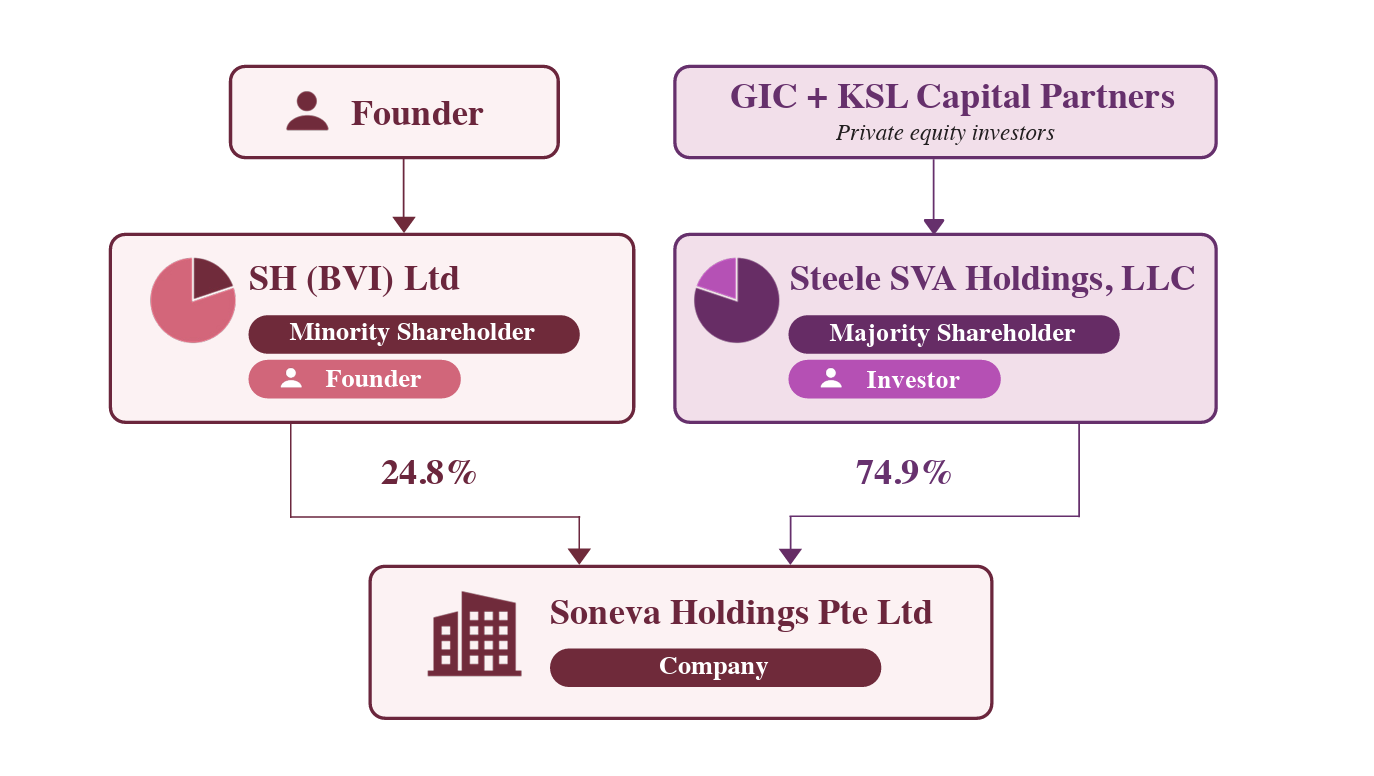
SH (BVI) Ltd. (“Founder”) is the founder’s vehicle holding approximately 24.8% of Soneva Holdings Pte Ltd (“Company”), the holding company of the Soneva luxury resorts in the Maldives. Steele SVA Holdings, LLC (“Investor”) is a private equity investment vehicle holding approximately 74.9% of the Company.
The relationship between the Founder and the Investor broke down in 2024, leading to two prior SICC proceedings. In May 2025, the Investor converted its convertible debt securities into equity, and became the majority shareholder. Days later, the parties concluded a mediated settlement and entered into a new shareholders’ agreement (“SHA”) giving control of the board to the Investor while the Founder relinquished its veto rights, forfeiting its ability to block (i) issue of securities; (ii) Emergency Funding mechanism (explained below); and (iii) a sale of the Company by the Investor, including through its drag-along right. The parties also agreed to use all reasonable endeavours to exit the Company by 15 November 2026.
The SHA contained the usual “Emergency Funding” mechanism for meeting the Company’s cash needs at 15% per annum, with no exit premium.2
The Investor’s nominee directors used this mechanism to raise USD 20 million from the Investor at 15% per annum.
In August 2025, the Company required further funding. This time, the Investor’s nominee directors, acting alone, approved a facility of up to USD 37 million structured as a new class of “Class H Debt Securities”, rather than Emergency Funding. Why? The Class H Debt Securities carried an 18% coupon and a “Mandatory Redemption Event”, which entitled the Investor to twice the outstanding amount (including accrued interest).3 Unlike the usual redemption events, which assure an investment multiple, this included a multiple on accrued compounded interest. The Founder was indeed offered to subscribe pro rata within three days, failing which the Investor took up the entire subscription.
The Founder challenged the issue as oppressive under section 216 of the Singapore Companies Act 1967 and sought an order that the Investor buy out its stake for approximately USD 70.8 million.
Outcome
The Court applied the settled two-step test.
First, it identified the Founder’s legitimate expectations. Then, it asked whether the Investor’s conduct departed from them to an extent that was commercially unfair.
The Court accepted that the Company genuinely needed funding, and that the issue was validly approved under the SHA. It nonetheless found that the issue of the Class H Debt Securities breached the Founder’s legitimate expectations and was oppressive, because:
i. the quantum of debt went beyond the Company’s actual requirement;
ii. the returns were extortionate;
iii. the terms were structured to deter the Founder from participating;
iv. the agreed Emergency Funding mechanism was bypassed; and
v. the Founder’s directors were excluded from meaningful deliberation.4
Remedy for oppression usually sought (and often granted) is a put on the majority shareholder. The Court refused the buy-out. The Court refused to override the exit mechanism in the SHA and required both parties to use all reasonable endeavours to achieve an exit event by 15 November 2026.
To put an end to the oppressive conduct separately, the Court: (i) reduced the coupon to the originally agreed Emergency Funding rate of 15% (as against 18%), and removed the 2x multiple on redemption; (ii) directed the Investor to procure the Company to commence a sale process by 15 November 2026; and (iii) barred any further financing on similar terms until the sale process was completed.5
Beyond the outcome, the judgment shows how a majority investor can act within its contractual rights and still oppress the minority. The key findings follow.
- The quantum was not tied to the Company’s actual need, and alternatives were not explored
The Court accepted that the Company had a genuine and pressing need for capital, but did it need USD 37 million? It did not. While the first USD 12 million drawdown was needed, the balance USD 25 million remained largely undrawn.
The Investor argued that it was important for the Company to establish a line of credit. The Court disagreed on the quantum of USD 37 million, particularly considering the onerous terms of credit. Had the full USD 37 million been drawn, the Class H terms would have given the Investor an annualised return (IRR) of 136% on a sale after one year and 48% on a sale after three years, by which time the Investor would be owed about USD 121.6 million, more than three times the principal. The same funding under the Emergency Funding mechanism would have returned 15%.
Nor was the market tested. The Investor knew of more than 70 potential lenders but barely engaged them, and never approached two that had earlier offered to finance the group. Meanwhile, the existing lender offered USD 20 million within three months of the Class H issue. - The agreed Emergency Funding mechanism could not be bypassed
The Investor argued that Emergency Funding was optional, as nothing in the SHA barred other routes such as a regular issue of securities.6
The Court disagreed. A Liquidity Need had arisen, and the Investor, bound to act reasonably and in good faith, could not ignore it to avoid triggering the mechanism. It “shall” issue a funding request on the agreed terms.7
The two routes sit together: the general issuance provisions decide who approves an issue; Emergency Funding decides the terms on which shareholders fund a Liquidity Need. The parties had widened the mechanism in 2025 to cover all Liquidity Needs, which would make little sense if it were optional. And the Investor had itself used it months earlier for indistinguishable needs.8 - The terms were structured to deter the Founder from participating
The Investor’s refrain was that the Founder was offered the same terms and chose not to subscribe (the founder admitted he would have deployed his capital elsewhere). Beside the point, said the Court: a right to subscribe does not cure unfair terms.9
The fine print told a different story. The Founder could not assign or encumber its Class H securities; the Investor could. The Investor’s justification was that the Founder’s lender might interfere with a future sale.10
The Court found this too tenuous. Transfer restrictions may make sense for equity, but a lender holding security over debt securities gets no governance rights in the Company.11 A narrower restriction would have done.12 With its shares already charged to the Investor, the Founder was left with no way to fund its subscription. Finding no legitimate rationale for the asymmetry, the Court called it the “tipping point”: the restriction was designed to deter the Founder from subscribing.
The board could also redeem a defaulting holder’s Class H securities at 82% of the subscription price, forfeiting all coupons and the multiplier. Symmetrical on paper, but usable only against the Founder: an Investor-controlled board would hardly find the Investor in default. Absent bad faith, the Court treated this as a “practical concern” rather than oppression in itself.13 - Formal compliance did not amount to meaningful participation
The Investor’s answer was simple: the Founder had no veto and was offered the chance to subscribe. The Court distinguished the right to veto a decision from the right to participate in it. Giving up the veto did not extinguish the Founder’s expectation of being genuinely consulted.14
That expectation was breached. The Investor’s nominees settled the method, quantum, structure and terms, and approved the issue, before the proposal reached the Founder’s directors (on a Sunday), leaving only the three-day window under the SHA. The Investor’s representative accepted in crossexamination that he saw no need to explain the terms to the other shareholders.
The Founder was handed a decision already made. Formal compliance with the SHA was not meaningful participation.15
Key takeaways in detail
Nothing stops a majority investor from rescuing a struggling portfolio company. But board control, veto carve-outs and procedural compliance will not, by themselves, protect the terms of the rescue.
- Be very cautious if you’re the majority shareholder. The risk arises because the party setting the terms also controls the company. Similar pricing agreed upfront with the founder would be far harder to attack; shortfall funding in Indian PE documents is often priced at 18–20%.
- Size rescue funding to the need, and document it. Base the quantum on cash flow forecasts and board papers, minute the deliberations, and tranche against identified needs.
- Check alternative funding. Get alternative term sheets, and keep a record of who was approached and what was offered. Price against market evidence: internal hurdle rates (a 20% IRR target) and penalty rates in earlier instruments do not count. If you want the freedom to fund outside an agreed emergency funding mechanism, say so expressly.
- Nominee directors’ duties to the company as a whole remain the minority’s key protection. They survive even comprehensive documents negotiated by sophisticated parties. Losing a veto does not mean losing the right to be heard: engage the minority’s directors before terms are settled, not after. Where investor nominees approve investor funding, consider an independent committee or a fairness opinion. Pre-emption rights are no defence if the terms make participation impractical, and clauses that are symmetrical on paper will be judged by how they work in practice.
- The remedy may not be a buy-out. The Court enforced the agreed exit mechanism and rewrote the instrument instead: 15%, no multiple, and a sale process by the agreed exit date. That cut both ways. The Investor avoided buying out the Founder for about USD 70.8 million, but lost control over the timing of the sale. Draft exit clauses with both outcomes in mind.
1 [2026] SGHC(I) 20.
2 Para 25-27, 145-148.
3 Para 8, 33.
4 Para 144, 166, 177-178.
5 Para 189-192.
6 Para 151-155.
7 Para 152-154.
8 Para 156-163.
9 Para 127-129.
10 Para 137-139.
11 Para 140-141.
12 Para 142.
13 Para 131-136.
14 Para 52(b), (f), 169-172.
15 Para 173-176.
The Singapore International Commercial Court’s (“SICC”) recent decision in SH (BVI) Ltd v Steele SVA Holdings, LLC1 examines when rescue funding provided by a private equity investor to its portfolio company may amount to oppression of the minority founder. The SICC held that the majority investor’s issue of high-yield debt securities to itself was oppressive, even though the issue was validly approved under the shareholders’ agreement, and rewrote the economics of the instrument.
Key Takeaways for investors
- Be very cautious if you’re the majority shareholder
- Size rescue funding to a documented need – keep it to the extent required
- Check alternative funding – good idea to get your alternative term sheets
- Nominee directors’ duties to the company as a whole remain the minority’s key protection
- Remedy for oppression may not always be a buy-out; the Court enforced the exit methodology agreed in the shareholders’ agreement
Background
SH (BVI) Ltd. (“Founder”) is the founder’s vehicle holding approximately 24.8% of Soneva Holdings Pte Ltd (“Company”), the holding company of the Soneva luxury resorts in the Maldives. Steele SVA Holdings, LLC (“Investor”) is a private equity investment vehicle holding approximately 74.9% of the Company.
The relationship between the Founder and the Investor broke down in 2024, leading to two prior SICC proceedings. In May 2025, the Investor converted its convertible debt securities into equity, and became the majority shareholder. Days later, the parties concluded a mediated settlement and entered into a new shareholders’ agreement (“SHA”) giving control of the board to the Investor while the Founder relinquished its veto rights, forfeiting its ability to block (i) issue of securities; (ii) Emergency Funding mechanism (explained below); and (iii) a sale of the Company by the Investor, including through its drag-along right. The parties also agreed to use all reasonable endeavours to exit the Company by 15 November 2026.
The SHA contained the usual “Emergency Funding” mechanism for meeting the Company’s cash needs at 15% per annum, with no exit premium.2
The Investor’s nominee directors used this mechanism to raise USD 20 million from the Investor at 15% per annum.
In August 2025, the Company required further funding. This time, the Investor’s nominee directors, acting alone, approved a facility of up to USD 37 million structured as a new class of “Class H Debt Securities”, rather than Emergency Funding. Why? The Class H Debt Securities carried an 18% coupon and a “Mandatory Redemption Event”, which entitled the Investor to twice the outstanding amount (including accrued interest).3 Unlike the usual redemption events, which assure an investment multiple, this included a multiple on accrued compounded interest. The Founder was indeed offered to subscribe pro rata within three days, failing which the Investor took up the entire subscription.
The Founder challenged the issue as oppressive under section 216 of the Singapore Companies Act 1967 and sought an order that the Investor buy out its stake for approximately USD 70.8 million.
Outcome
The Court applied the settled two-step test.
First, it identified the Founder’s legitimate expectations. Then, it asked whether the Investor’s conduct departed from them to an extent that was commercially unfair.
The Court accepted that the Company genuinely needed funding, and that the issue was validly approved under the SHA. It nonetheless found that the issue of the Class H Debt Securities breached the Founder’s legitimate expectations and was oppressive, because:
i. the quantum of debt went beyond the Company’s actual requirement;
ii. the returns were extortionate;
iii. the terms were structured to deter the Founder from participating;
iv. the agreed Emergency Funding mechanism was bypassed; and
v. the Founder’s directors were excluded from meaningful deliberation.4
Remedy for oppression usually sought (and often granted) is a put on the majority shareholder. The Court refused the buy-out. The Court refused to override the exit mechanism in the SHA and required both parties to use all reasonable endeavours to achieve an exit event by 15 November 2026.
To put an end to the oppressive conduct separately, the Court: (i) reduced the coupon to the originally agreed Emergency Funding rate of 15% (as against 18%), and removed the 2x multiple on redemption; (ii) directed the Investor to procure the Company to commence a sale process by 15 November 2026; and (iii) barred any further financing on similar terms until the sale process was completed.5
Beyond the outcome, the judgment shows how a majority investor can act within its contractual rights and still oppress the minority. The key findings follow.
- The quantum was not tied to the Company’s actual need, and alternatives were not explored
The Court accepted that the Company had a genuine and pressing need for capital, but did it need USD 37 million? It did not. While the first USD 12 million drawdown was needed, the balance USD 25 million remained largely undrawn.
The Investor argued that it was important for the Company to establish a line of credit. The Court disagreed on the quantum of USD 37 million, particularly considering the onerous terms of credit. Had the full USD 37 million been drawn, the Class H terms would have given the Investor an annualised return (IRR) of 136% on a sale after one year and 48% on a sale after three years, by which time the Investor would be owed about USD 121.6 million, more than three times the principal. The same funding under the Emergency Funding mechanism would have returned 15%.
Nor was the market tested. The Investor knew of more than 70 potential lenders but barely engaged them, and never approached two that had earlier offered to finance the group. Meanwhile, the existing lender offered USD 20 million within three months of the Class H issue. - The agreed Emergency Funding mechanism could not be bypassed
The Investor argued that Emergency Funding was optional, as nothing in the SHA barred other routes such as a regular issue of securities.6
The Court disagreed. A Liquidity Need had arisen, and the Investor, bound to act reasonably and in good faith, could not ignore it to avoid triggering the mechanism. It “shall” issue a funding request on the agreed terms.7
The two routes sit together: the general issuance provisions decide who approves an issue; Emergency Funding decides the terms on which shareholders fund a Liquidity Need. The parties had widened the mechanism in 2025 to cover all Liquidity Needs, which would make little sense if it were optional. And the Investor had itself used it months earlier for indistinguishable needs.8 - The terms were structured to deter the Founder from participating
The Investor’s refrain was that the Founder was offered the same terms and chose not to subscribe (the founder admitted he would have deployed his capital elsewhere). Beside the point, said the Court: a right to subscribe does not cure unfair terms.9
The fine print told a different story. The Founder could not assign or encumber its Class H securities; the Investor could. The Investor’s justification was that the Founder’s lender might interfere with a future sale.10
The Court found this too tenuous. Transfer restrictions may make sense for equity, but a lender holding security over debt securities gets no governance rights in the Company.11 A narrower restriction would have done.12 With its shares already charged to the Investor, the Founder was left with no way to fund its subscription. Finding no legitimate rationale for the asymmetry, the Court called it the “tipping point”: the restriction was designed to deter the Founder from subscribing.
The board could also redeem a defaulting holder’s Class H securities at 82% of the subscription price, forfeiting all coupons and the multiplier. Symmetrical on paper, but usable only against the Founder: an Investor-controlled board would hardly find the Investor in default. Absent bad faith, the Court treated this as a “practical concern” rather than oppression in itself.13 - Formal compliance did not amount to meaningful participation
The Investor’s answer was simple: the Founder had no veto and was offered the chance to subscribe. The Court distinguished the right to veto a decision from the right to participate in it. Giving up the veto did not extinguish the Founder’s expectation of being genuinely consulted.14
That expectation was breached. The Investor’s nominees settled the method, quantum, structure and terms, and approved the issue, before the proposal reached the Founder’s directors (on a Sunday), leaving only the three-day window under the SHA. The Investor’s representative accepted in crossexamination that he saw no need to explain the terms to the other shareholders.
The Founder was handed a decision already made. Formal compliance with the SHA was not meaningful participation.15
Key takeaways in detail
Nothing stops a majority investor from rescuing a struggling portfolio company. But board control, veto carve-outs and procedural compliance will not, by themselves, protect the terms of the rescue.
- Be very cautious if you’re the majority shareholder. The risk arises because the party setting the terms also controls the company. Similar pricing agreed upfront with the founder would be far harder to attack; shortfall funding in Indian PE documents is often priced at 18–20%.
- Size rescue funding to the need, and document it. Base the quantum on cash flow forecasts and board papers, minute the deliberations, and tranche against identified needs.
- Check alternative funding. Get alternative term sheets, and keep a record of who was approached and what was offered. Price against market evidence: internal hurdle rates (a 20% IRR target) and penalty rates in earlier instruments do not count. If you want the freedom to fund outside an agreed emergency funding mechanism, say so expressly.
- Nominee directors’ duties to the company as a whole remain the minority’s key protection. They survive even comprehensive documents negotiated by sophisticated parties. Losing a veto does not mean losing the right to be heard: engage the minority’s directors before terms are settled, not after. Where investor nominees approve investor funding, consider an independent committee or a fairness opinion. Pre-emption rights are no defence if the terms make participation impractical, and clauses that are symmetrical on paper will be judged by how they work in practice.
- The remedy may not be a buy-out. The Court enforced the agreed exit mechanism and rewrote the instrument instead: 15%, no multiple, and a sale process by the agreed exit date. That cut both ways. The Investor avoided buying out the Founder for about USD 70.8 million, but lost control over the timing of the sale. Draft exit clauses with both outcomes in mind.
1 [2026] SGHC(I) 20.
2 Para 25-27, 145-148.
3 Para 8, 33.
4 Para 144, 166, 177-178.
5 Para 189-192.
6 Para 151-155.
7 Para 152-154.
8 Para 156-163.
9 Para 127-129.
10 Para 137-139.
11 Para 140-141.
12 Para 142.
13 Para 131-136.
14 Para 52(b), (f), 169-172.
15 Para 173-176.
AI Generated Podcast
This is an AI-generated (unedited and unreviewed) podcast for this article.
Recent Research
View All →
Loading recent analysis...
Loading recent analysis...

Only Indian law firm commended for Innovation in ‘Dealmaking’ category
at the FT Innovative Lawyers Awards Asia-Pacific 2024
Join our Whatsapp Community
Click here or scan the QR code to join our WhatsApp community